Feb23
Posted on Feb 23 by
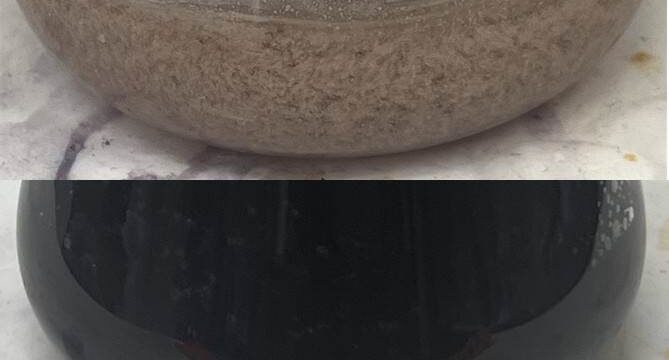
Something that I learned recently was that there is always growth! This is a picture of a control plate in which no growth of E.coli was expected. After allowing to incubate overnight, there appeared to be colonies. I learned that this is due to non-sterile conditions, as there is no way in our lab setting to be perfectly sterile. Contaminants in the air unavoidably adhered on the plate in the time it took to pipette the control sample onto it and caused the small amount of growth seen here. I think this is interesting because it demonstrates how small, unnoticeable particles can make such a difference in your results! So, sometimes you’re the bug and sometimes you’re the windshield. I think this statement has been relevant in these past weeks. In trying to sequence the strands of DNA, there have been some unforeseen results that we have had to work around. In those instances we were the bug. When it is determined what went wrong and we are able to continue with the sequencing, we will again be the...
Feb17
Posted on Feb 17 by
Jason Miech, a sophomore at Emmanuel College, is working on analyzing the effect flow rate has on liquid-liquid interactions within a microfluidic flow cell.
Feb05
Posted on Feb 5 by
Congrats to Kayla! She will take new steps towards her dream of becoming a dentist, DDS, this summer. She’s been accepted to the Tufts University School of Dental Medicine and can’t wait to get started. We hope that her work with nanoparticles and hydroxyapatite helped her along the way. Congrats...
Jan28
Posted on Jan 28 by
Welcome back to the research group and all Emmanuel students. Classes started over a week ago and we’re off to a great start. Look for more blog posts from the group this semester! We have a lot going...
Dec01
Posted on Dec 1 by
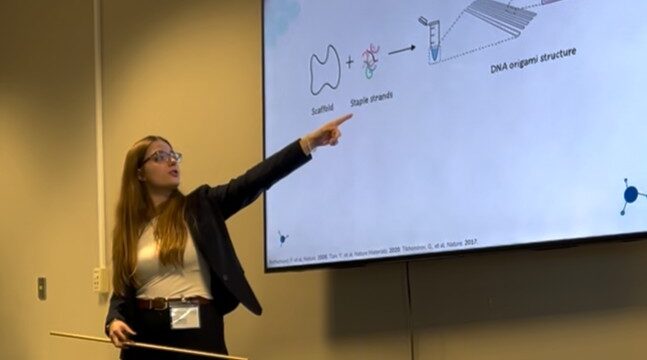
Prof. Gerdon presented the group’s work at the Materials Research Society (MRS) conference in Boston on Monday, Nov 30th. The talk was titled “Effects of Multi-Stream Microfluidic Solution Control on DNA-Templated Calcium Phosphate Mineralization” and focused on the work that Sunaro Ngourn began and Geoff Conklin completed. Some future work highlighted the rheological experiments that Aimee Sanford is currently working on. The talk was in a great session on Engineering and Application of Bioinspired Materials. It’s always great to be surrounded by great minds in...
Nov12
Posted on Nov 12 by
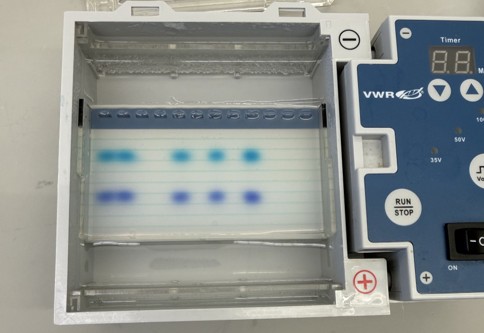
A technique I learned this week was gel electrophoresis! The gel containing wells of DNA sample sits in a bath of ions that conduct electricity. As the electricity from the power pack moves through the gel, the DNA’s negative charge pulls it through the gel towards the positive pole. The different bands indicate the size of the DNA, as smaller pieces move further down the gel than the bigger pieces. It is then imaged using an intercalating dye and UV light as can be seen on the screen in the back!...